|
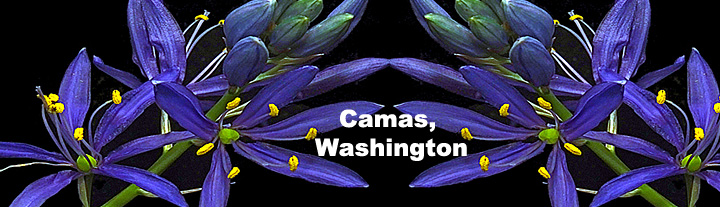
| The lovely town of Camas is named after the "Camas Lily" (Camassia quamash), a beautiful blue wildflower of the Pacific northwest. Camas bulbs were an important food source for many Native American tribes. These bulbs, which could be used as a vegetable or in bread, often saved tribes from starvation. They are very important plants in the history of this region, including the Lewis & Clark expedition. For more information please visit Camas Page 1 at above URL. |
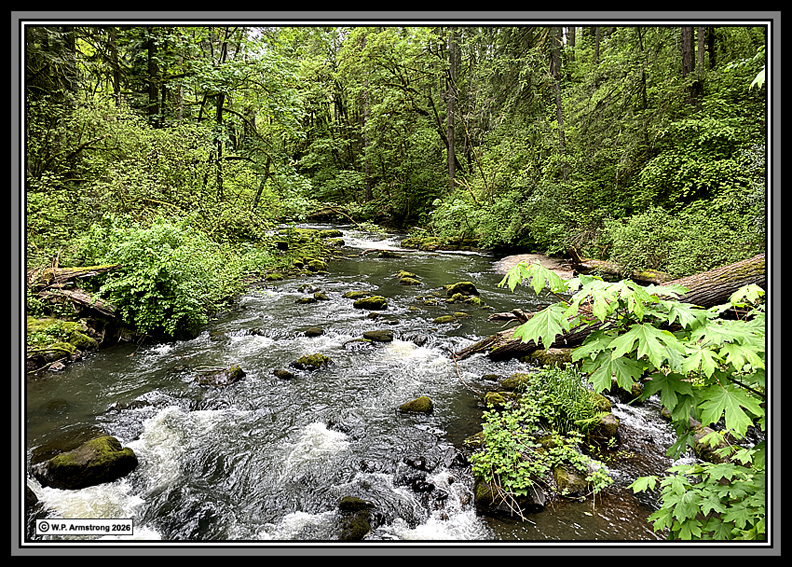
| It occured to me that the camas bulbs I ordered from Amazon produced plants that were different from the ones I photographed at Lacamas Creek in Camas, Washington. In addition, I discovered that Camassia taxonomy is actually quite complex with 6 verified species in North America, including several species in the Pacific northwest. In addition, there are several named cultivated varieties with common names appearing in single quotation marks. As a botanist I felt compelled to add this Camas #4 page with more detailed taxonomic information from iNaturalist. |
|
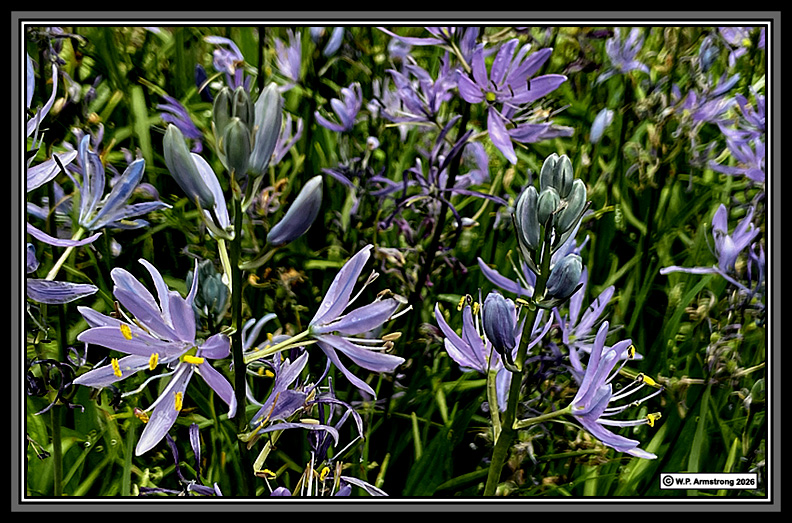
Camas (Camassia quamash) in meadow above Lacamas Creek.
|
|
Historically, the genus was placed in the lily family (Liliaceae), when this was very broadly defined to include most lilioid monocots. When the Liliaceae was split, Camassia was placed in a family called Hyacinthaceae (now the subfamily Scilloideae). DNA and biochemical studies have led the Angiosperm Phylogeny Group to reassign Camassia to the family Asparagaceae, subfamily Agavoideae. Camassia placed in Asparagus family is surprising to me; however, DNA sequencing is the modern phylogenetic tool and it must be followed consistently. Note: The Jepson Flora of California has retained Camassia in the Agave family (Agavaceae). The World Checklist of Selected Plant Families recognizes six species as of April 2025: 1. Camassia angusta (Engelm. & A.Gray) Blank. - "Prairie Camas" Southern Great Plains + mid-Mississippi Valley (Texas, Oklahoma, Louisiana, Arkansas, Missouri, Kansas, Iowa, Illinois, Indiana). 2. Camassia cusickii S.Watson. - "Cusick's Camas" - Northeastern Oregon, west-central Idaho. 3. Camassia howellii S.Watson. - "Howell's Camas" - Southwestern Oregon. 4. Camassia leichtlinii (Baker) S.Watson. - "Large Camas", "Great Camas" - British Columbia, Washington, Oregon, northern + central California, Washoe County in Nevada. 5. Camassia quamash (Pursh) Greene. - "Quamash", "Indian Camas", "Small Camas" - Western Canada (British Columbia, Alberta), western United States (California, Oregon, Washington, Nevada, Idaho, Montana, Wyoming, Utah). 6. Camassia scilloides (Raf.) Cory. - "Atlantic Camas", "Bear Grass" - Eastern + central North America from Maryland to Georgia, westward to Texas and north into Ontario. |
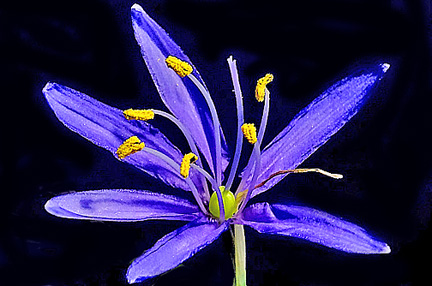 |
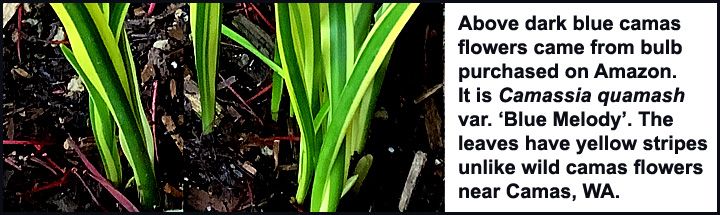
Camassia quamash 'Blue Melody' is a cultivated variety of the native North American common camas, originating from species found in western Sierra Nevada meadows and Pacific Northwest wet prairies. It is distinguished by its, deep blue-purple flowers and distinct green & yellow (cream colored), striped leaves. |
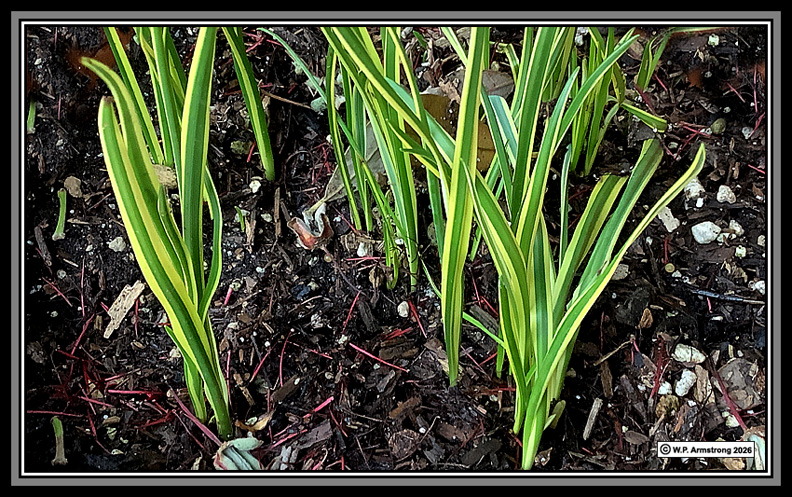
| The Camassia quamash variety 'Blue Melody' grown at Wayne's Word is different from Camassia population in meadow above Lacamas Creek. 'Blue Melody' has yellow striped leaves and darker purple flowers. |
